Address
304 North Cardinal St.
Dorchester Center, MA 02124
Work Hours
Monday to Friday: 7AM - 7PM
Weekend: 10AM - 5PM
Address
304 North Cardinal St.
Dorchester Center, MA 02124
Work Hours
Monday to Friday: 7AM - 7PM
Weekend: 10AM - 5PM


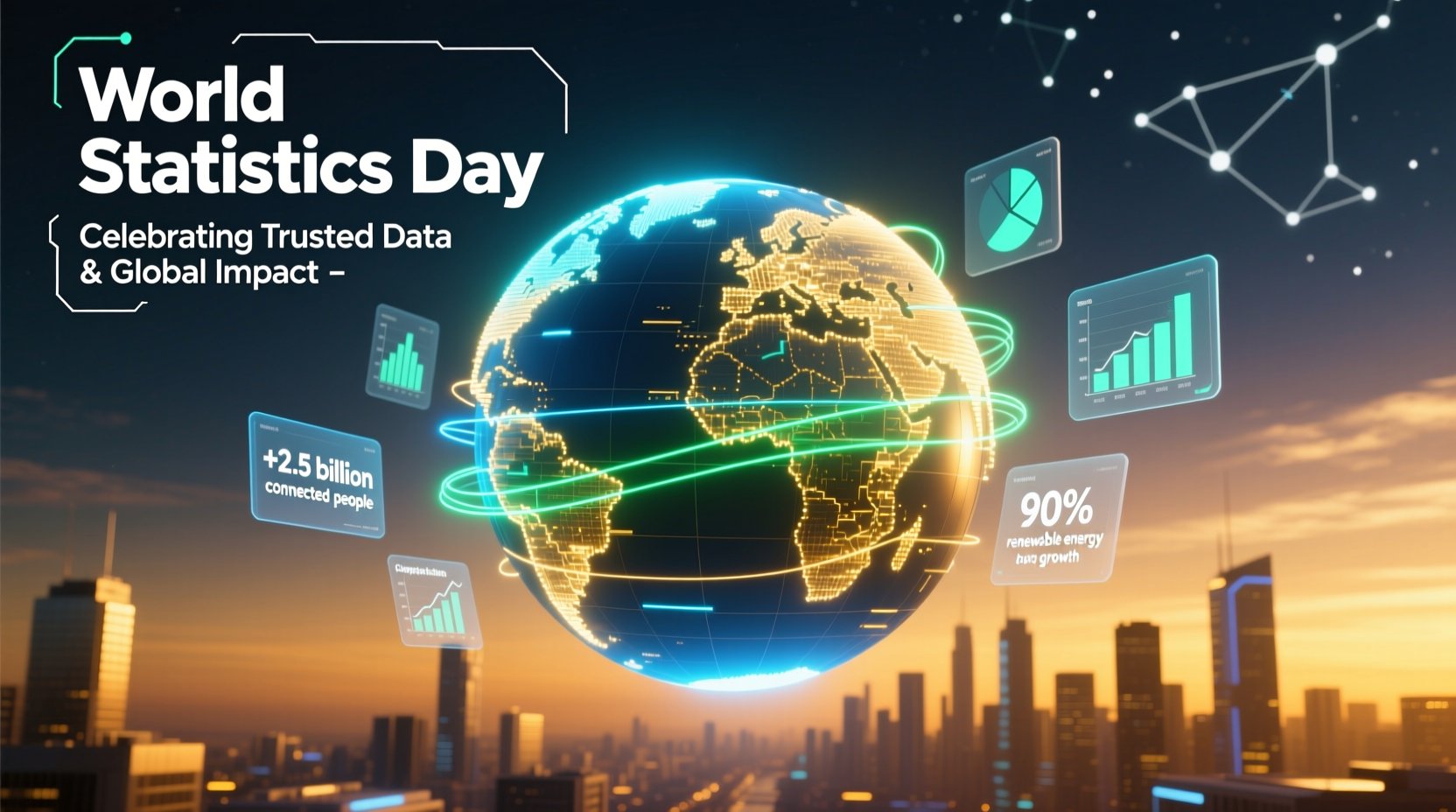
Every five years, the world pauses to recognize the critical role of data in shaping societies, guiding policies, and driving sustainable development. World Statistics Day, observed on October 20th, celebrates the achievements of national statistical systems and underscores the importance of trustworthy, timely, and accessible data. Instituted by the United Nations General Assembly through Resolution A/RES/69/282, this international day highlights how high-quality statistics form the backbone of informed decision-making in government, business, science, and everyday life.
In an age defined by information overload and misinformation, World Statistics Day serves as a vital reminder that not all data is created equal. It champions transparency, professional ethics, and methodological rigor in statistical practices worldwide. From tracking poverty rates to measuring climate change impacts, official statistics empower nations to monitor progress toward global goals like the Sustainable Development Goals (SDGs). This article explores the origins, purpose, global reach, and lasting impact of World Statistics Day — a celebration of facts, evidence, and truth in service of humanity.
The journey toward establishing World Statistics Day began with growing recognition of the need for reliable data governance across nations. In 2010, the first-ever observance took place under the theme ‘Celebrating Excellence in Official Statistics’, marking a milestone in global statistical cooperation. Encouraged by its success, the United Nations Statistical Commission advocated for a recurring international day dedicated to statistics.
This advocacy culminated in December 2015, when the UN General Assembly adopted Resolution A/RES/69/282, officially designating October 20 as World Statistics Day, to be celebrated every five years. The five-year cycle aligns with broader assessments of statistical capacity and allows time for meaningful preparation, reflection, and innovation within national statistical offices (NSOs).
The inaugural resolution emphasized three core principles:
These foundational goals continue to guide each iteration of the observance.
The most recent celebration occurred in 2020, during a year marked by unprecedented global challenges — including the COVID-19 pandemic. That year’s theme, ‘Connecting the World with Data We Can Trust’, resonated deeply as governments relied heavily on real-time health, economic, and social data to respond effectively.
The central mission of World Statistics Day is to promote confidence in official statistics. In a world increasingly influenced by algorithms, artificial intelligence, and user-generated content, ensuring the integrity of data has never been more crucial. Unlike anecdotal or biased sources, official statistics are collected using scientific methods, peer-reviewed standards, and strict confidentiality protocols.
One of the key purposes of this international day is to highlight how robust statistical infrastructure supports evidence-based policymaking. Consider these areas where accurate statistics make a tangible difference:
| Area | Role of Statistics | Real-World Example |
|---|---|---|
| Public Health | Tracking disease outbreaks, vaccination rates, mortality trends | COVID-17 case reporting enabled targeted lockdowns and vaccine distribution |
| Economic Planning | Measuring GDP, inflation, employment, trade balances | National budgets shaped by unemployment data from labor force surveys |
| Education Policy | Monitoring school enrollment, dropout rates, gender parity | Data revealed disparities leading to girls’ education initiatives in Sub-Saharan Africa |
| Climate Action | Recording emissions, deforestation, temperature changes | UNFCCC reports rely on nationally reported greenhouse gas inventories |
Beyond informing policy, World Statistics Day also fosters accountability. When governments publish transparent data, citizens can hold leaders responsible for promises made — especially regarding commitments under the 2030 Agenda for Sustainable Development. For instance, SDG Indicator 1.1.1 tracks the proportion of the population living below the international poverty line, enabling cross-country comparisons and progress evaluation.
Moreover, the day encourages investment in modernizing statistical systems. Many developing countries face challenges such as outdated technology, limited funding, and insufficient training. International support mechanisms, often coordinated through the UN, help bridge these gaps. Initiatives like the Global Strategy to Improve Agricultural and Rural Statistics or the PARIS21 Partnership exemplify collaborative efforts boosted by the visibility of World Statistics Day.
World Statistics Day is not just a symbolic gesture — it inspires concrete action across continents. On October 20, national statistical offices, academic institutions, civil society organizations, and private sector partners organize events ranging from data hackathons to public lectures and media campaigns.
For example:
International agencies play a pivotal coordinating role. The United Nations Statistics Division (UNSD) leads global coordination, providing toolkits, logos, and multilingual resources to facilitate participation. Regional commissions — such as ECA (Africa), ECE (Europe), ESCAP (Asia-Pacific), and ECLAC (Latin America) — tailor outreach to regional priorities.
A notable outcome of increased global engagement has been the rise of National Strategies for the Development of Statistics (NSDS). These strategic frameworks, promoted by the World Bank and UN, help countries align their statistical activities with development objectives. As of 2023, over 80 countries have implemented or updated their NSDS with technical assistance linked to momentum generated around World Statistics Day.
Additionally, the day amplifies voices from underrepresented regions. Indigenous communities, for instance, are increasingly involved in co-producing data that reflects their realities — challenging historical exclusion from mainstream statistics. This shift toward inclusive, participatory data collection embodies the spirit of the day.
World Statistics Day is far more than a ceremonial observance; it is a powerful catalyst for building a world grounded in facts, equity, and accountability. By honoring the dedication of statisticians and advocating for stronger data ecosystems, this international day strengthens our collective ability to confront global challenges — from pandemics to inequality to environmental degradation.
As individuals, we benefit daily from reliable statistics, whether checking weather forecasts, analyzing job markets, or understanding public health risks. Recognizing the painstaking work behind these numbers fosters appreciation and trust in institutions that serve the public good.
To learn more about how data shapes our world and how you can get involved, visit the official United Nations page for World Statistics Day. Explore educational materials, past themes, and ways your organization or community can participate in future celebrations. Together, we can ensure that data we can trust remains at the heart of progress for generations to come. 📊🌍✨