Address
304 North Cardinal St.
Dorchester Center, MA 02124
Work Hours
Monday to Friday: 7AM - 7PM
Weekend: 10AM - 5PM
Address
304 North Cardinal St.
Dorchester Center, MA 02124
Work Hours
Monday to Friday: 7AM - 7PM
Weekend: 10AM - 5PM


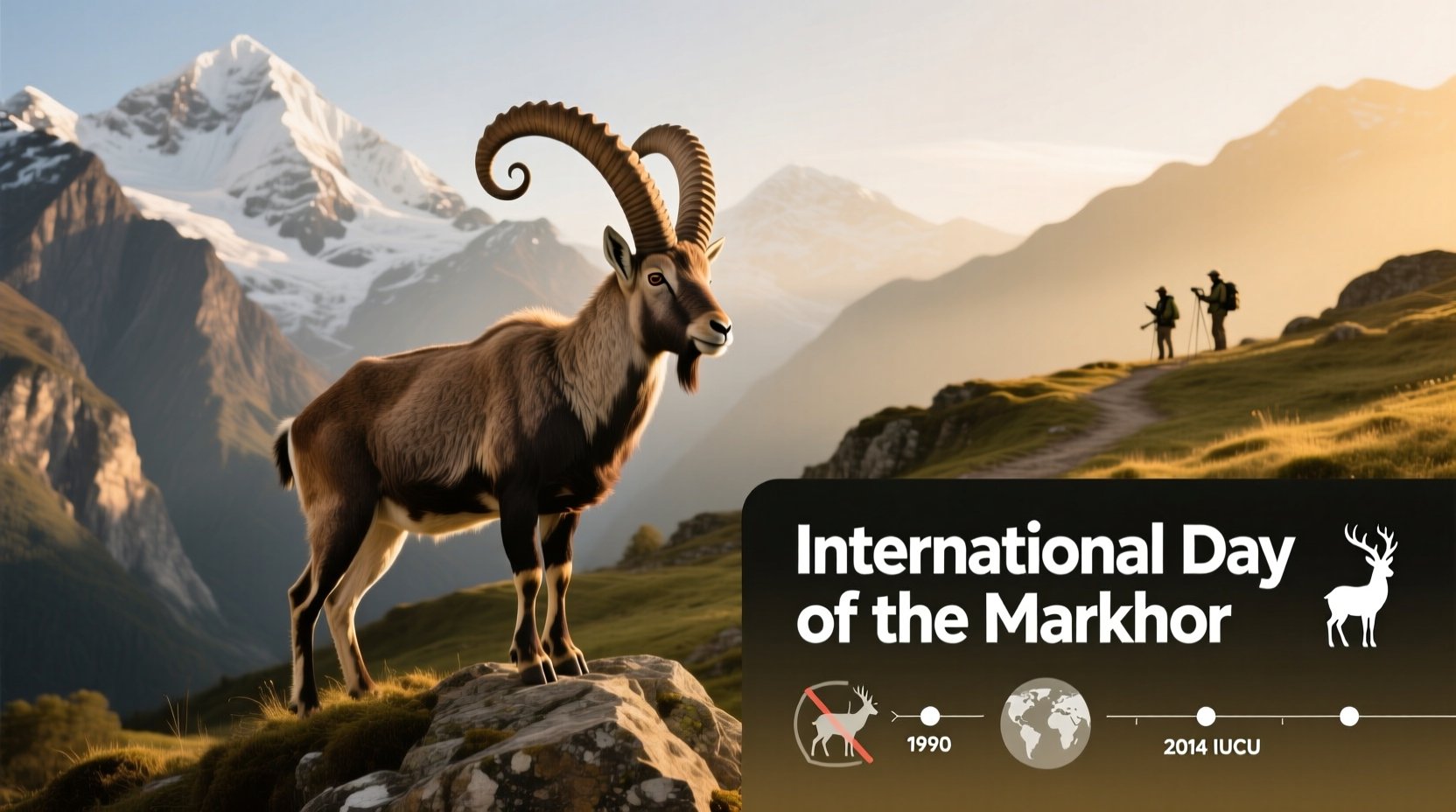
The International Day of the Markhor, observed annually on May 24, stands as a powerful symbol of global commitment to biodiversity conservation and sustainable coexistence between humans and nature. Officially proclaimed by the United Nations General Assembly through Resolution A/RES/78/278, this international observance spotlights the remarkable markhor (Capra falconeri)—a wild mountain goat native to South and Central Asia renowned for its spiraling horns and ecological significance 🐐. More than just a tribute to an endangered species, this day serves as a rallying point for governments, conservationists, indigenous communities, and citizens worldwide to unite in protecting fragile mountain ecosystems.
Established with strong advocacy from Pakistan—the country where the markhor is both the national animal and a flagship conservation success story—the International Day of the Markhor reflects growing international recognition that preserving iconic species contributes directly to climate resilience, ecosystem balance, and cultural heritage preservation 🛡️. As one of the most visually striking members of the Caprinae subfamily, the markhor inhabits steep, rugged terrains across Afghanistan, India, Tajikistan, Uzbekistan, and particularly northern Pakistan, including regions like Gilgit-Baltistan and Khyber Pakhtunkhwa.
The journey of the markhor from the brink of extinction to becoming a celebrated emblem of ecological recovery is nothing short of extraordinary. In the early 20th century, unregulated hunting, habitat loss due to deforestation, and human encroachment drastically reduced markhor populations. By the 1980s, the species was classified as Endangered on the IUCN Red List, with estimates suggesting fewer than 5,000 individuals remained in the wild.
A turning point came with community-based conservation initiatives pioneered in Pakistan. The Tor Ghara Project in Chitral and later programs under the Snow Leopard Trust and WWF-Pakistan demonstrated that involving local communities in wildlife monitoring, anti-poaching patrols, and ecotourism could yield transformative results. Hunters became protectors; villagers earned livelihoods through guided tours and conservation employment. These efforts led to a steady population rebound—by 2023, the IUCN reclassified the markhor as Near Threatened, marking one of Asia’s most successful large mammal recoveries 🎉.
The push for a dedicated UN observance began in earnest when Pakistan introduced Draft Resolution A/C.2/77/L.30 during the 77th session of the General Assembly, which eventually culminated in the adoption of A/RES/78/278 on May 18, 2024. This resolution formally designated May 24 as the International Day of the Markhor, recognizing not only the species’ biological importance but also its symbolic value in promoting peace, regional cooperation, and environmental stewardship.
The core purpose of the International Day of the Markhor extends far beyond raising awareness about a single species. It aims to highlight broader themes such as:
The impact of this international day has already begun to manifest. Since its proclamation, several countries have launched educational campaigns, school programs, and media features focused on high-altitude biodiversity. Scientific institutions are leveraging the occasion to publish new research on caprine genetics and habitat fragmentation. Meanwhile, digital outreach using hashtags like #SaveTheMarkhor and #MarkhorDay has amplified visibility across social platforms, engaging millions globally 🌐.
One notable outcome is increased funding for protected area expansion in markhor-inhabited zones. For instance, Pakistan announced the creation of two new wildlife corridors in 2024, connecting isolated populations in Kohistan and Hazarajat. Additionally, UNESCO has expressed interest in integrating markhor conservation into its Man and the Biosphere (MAB) program, further solidifying its status as a priority species for global action.
While rooted in South Asian ecology, the International Day of the Markhor has inspired truly global participation. Governments, NGOs, academic bodies, and grassroots organizations from over 60 countries participated in inaugural events in 2024. Below is a summary of key activities and contributors:
| Country | Organization | Activity | Impact |
|---|---|---|---|
| Pakistan | Ministry of Climate Change & Environment | National symposium in Islamabad; release of commemorative stamp | Increased public engagement; boosted tourism interest |
| Germany | Zoological Society for the Conservation of Species and Populations | Public exhibitions in Munich and Berlin zoos | Enhanced European awareness of Asian megafauna |
| Canada | University of British Columbia Biodiversity Lab | Webinar series on transhumant pastoralism and wildlife conflict | Fostered academic dialogue on coexistence strategies |
| India | Wildlife Institute of India | Camera trap surveys in Jammu & Kashmir | Updated population data for cross-border conservation planning |
| United States | Smithsonian Conservation Biology Institute | Social media campaign featuring 3D-animated markhor documentaries | Reached over 2 million viewers online |
Beyond formal events, schools around the world incorporated the markhor into science curricula, teaching children about adaptation, evolution, and conservation ethics. Art contests, essay competitions, and virtual reality experiences brought the creature’s majestic presence into classrooms and homes alike. Notably, Google featured a Doodle on May 24, 2024, celebrating the markhor—an endorsement that significantly broadened its reach.
International agencies such as the Convention on Migratory Species (CMS) and the Global Environment Facility (GEF) have pledged support for future initiatives aligned with the International Day, signaling institutional momentum behind sustained action.
The establishment of the International Day of the Markhor marks more than a ceremonial milestone—it represents a paradigm shift in how humanity values biodiversity. By honoring a species once teetering on extinction, we affirm our collective responsibility to safeguard Earth’s natural heritage. The markhor is not merely a national symbol of Pakistan; it is a living testament to what becomes possible when science, policy, tradition, and compassion converge.
This annual observance reminds us that every species lost diminishes the web of life, while every recovery offers hope. Whether through supporting conservation projects, advocating for stronger environmental policies, or simply learning more about the creatures we share our planet with, each individual can contribute to a more resilient world.
To deepen your understanding of this inspiring initiative and explore ways you can get involved, visit the official United Nations page for the International Day of the Markhor: https://www.un.org/en/observances/markhor-day. Together, let’s ensure that the spiraling horns of the markhor continue to crown the peaks of our planet—for generations to come 🏔️✨.